Technical Articles
article current location: Home > Technical Articles
 Release time:2026-10-05
 page views:
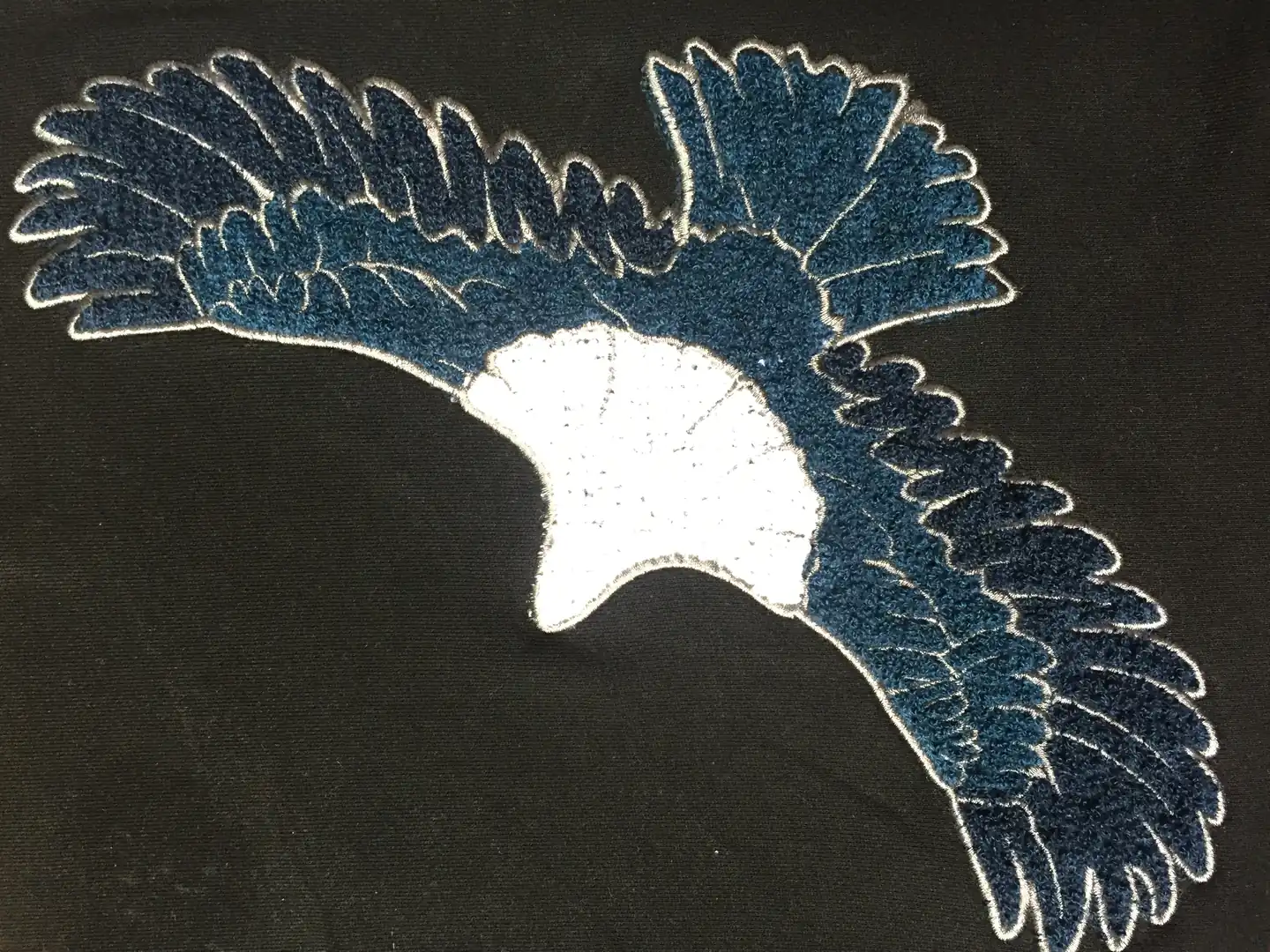
Chenille embroidery loops the thread over and over on the fabric to build continuous small loops — a 3D embroidery also called towel embroidery, loop-pile embroidery or chain-loop embroidery (“gou laang”). Loop height 2–6 mm, commonly 2–4 mm; the loop roots are heat-locked at the back. MOQ 300 pieces, sampling in 24–48 hours; suited to varsity lettering, hoodies, kidswear, home textiles and team badges.
Chenille embroidery loops a single thread over and over across the fabric, stitch after stitch, to produce rows of little loops — a soft, plump, thick 3D surface like towelling.
It feels like towelling and looks thick, and it is the classic technique behind American varsity lettering, team badges and retro hoodies. It is also one of the few 3D embroideries safe to use on garments worn next to the skin, including kidswear.
The difference from ordinary embroidery can be explained to a customer in one line:
Ordinary embroidery is flat; chenille embroidery is built up loop by loop — soft, thick and full of vintage character.
Chenille embroidery has an unusual number of names, and customers search with all sorts of words. Here they are in one place:
| Name | Explanation |
|---|---|
| Chenille embroidery | The most common name, from the towelling-like surface |
| Towel embroidery / loop-pile embroidery | Emphasises the looped structure; a standard trade name |
| “Gou laang” / “gou mao” | The customary name in South China and Hong Kong (in Cantonese “laang” means wool yarn) |
| “Mao mao” embroidery | A more colloquial market term |
| “Shou yao” (hand-cranked) | An older name surviving from the days when loops were formed on hand-cranked heads |
| Chain stitch / chain-loop embroidery | Refers to the chain stitch commonly used in chenille work, mainly for outlining and edging |
| English terms | Chenille Embroidery / Towel Embroidery / Loop-pile Embroidery / Moss Stitch |
Concepts that must be kept apart:
Chenille embroidery ≠ toothbrush embroidery.
The pile of chenille embroidery is a continuous series of small loops, soft, plump and lying flat; the thread of toothbrush embroidery is cut and left standing in columns, more resilient and upright. Remember it in one line: “want loops, choose chenille; want it standing, choose toothbrush.”
Chenille embroidery ≠ chain stitch.
The chain stitch is a stitch type in which one loop links into the next, and chenille work often uses it to edge and outline a motif (to prevent the border from fraying) — but it is not itself the looped structure of chenille embroidery. So when a customer searches “chain stitch embroidery”, we can still take the job, because almost every chenille factory uses it to finish the edges.
Chenille embroidery ≠ 3D puff embroidery.
3D puff embroidery is a solid, hard relief built over an EVA foam pad; chenille embroidery is a soft pile built out of loops.
Chenille embroidery relies on a dedicated chenille head (the “K head”):
Two stitch types work together:
There are two main ways of forming loops: chain-loop forming (mainstream — tight and durable) and yarn-catching (more plump, more common in home textiles and mats). Machines with combination heads can also switch between flat, chenille and cord (rope) embroidery on the same machine, producing several effects on one product.
Our production route (simplified, without internal process parameters):
Why does “locking the loop roots” deserve this much attention? Because the two common complaints about chenille embroidery are uneven loops and loops being pulled out. The first is controlled by stable tension and regular checking of the yarn catcher, the second by a heat-melt adhesive film that penetrates the needle holes at the back and locks the loop roots. Some low-cost methods stitch on the face only and never lock the roots across the reverse, so after a single wear-and-wash a loop can loosen or a thread pull. We calibrate the locking tension design by design and lock the roots across the whole reverse — that is the basis for our confidence that the loops are “locked down, not merely hung on the fabric”.
| Item | Specification |
|---|---|
| Loop height | 2–6 mm, commonly 2–4 mm; different loop heights can be set zone by zone within one design |
| Minimum stroke width | ≥ 4.0 mm |
| Letter height | recommended ≥ 5 mm; lettering below 5 mm is better done in high-density flat embroidery |
| Minimum overall motif size | recommended ≥ 50 mm |
| Common yarns | acrylic bulky yarn and woollen blend yarn; felt is commonly used as the ground |
| Automatic colour changes | about 6 colours as standard (machine-dependent) |
| Washing and durability | day to day we recommend a gentle machine or hand wash at 30–40℃, avoiding high-temperature drying and ironing |
Note: the above are standard capability ranges; the actual result is confirmed by sampling — loop height, density and colour reproduction all vary with fabric and artwork, so we insist on a physical sample before discussing volume.
Positioning: retro, varsity, sporty, warm and skin-friendly — suited to hoodies, baseball uniforms, kidswear, home textiles and team badges.
Good performance: hoodie fleece, loop-back fleece, flannel, knitted rib, denim and wool — with a felt ground the result is especially stable.
Possible with care: thin knits. We recommend switching to a fabric label or embroidered patch form and then sewing or heat-pressing it onto the finished product, avoiding large areas of loops formed directly on thin fabric, which distorts.
Handle with caution (must be discussed before ordering): highly elastic knits (tension must be calibrated design by design and interlining may be needed), and coated or silicone-finished fabrics (these affect adhesion of the backing lamination and must be adhesion-tested first).
Good product fits: retro hoodies, baseball uniforms, varsity jackets, knitwear, school and team badges, baseball caps, backpacks and handbags, cushions and blankets, mats, and cartoon motifs on kidswear. See the chenille embroidery section for more styles and case studies.
Not suitable — and we will say so up front: lettering with extremely fine strokes; large areas on ultra-thin fabric; products that must be completely flat and thin; photorealistic imagery; and areas of long-term, high-frequency friction (workwear cuffs, crotch, pocket edges).
| Technique | Form | Hand feel | Minimum stroke | Typical applications | Cost |
|---|---|---|---|---|---|
| Chenille | continuous loops | very soft, plump, thick | ≥ 4.0 mm | varsity letters, hoodies, kidswear, home textiles | medium |
| Toothbrush | upright columns, pile surface | soft and furry, more upright and resilient | ≥ 2.5–3.0 mm | hoodies / caps / bags / labels | medium-high |
| 3D puff | firm raised relief | solid, firm, hard-edged | ≥ 4.0–6.0 mm | cap badges, sportswear, firm logos | high |
| Imitation chenille (high-speed cord embroidery) | loop-like | thinner, lower cost | medium | smaller motifs, tight budgets | low-medium |
| Ordinary flat | flat | smooth, thin | fine letters possible | fine letters, small graphics, large areas | low |
In one line: soft, skin-friendly and varsity → chenille; upright and resilient → toothbrush; firm and hard-edged → 3D puff; small motifs on a tight budget → imitation chenille.
Below are the questions commonly asked about sampling and selection; see the FAQ page for more.
Q1 | What is the difference between chenille and toothbrush embroidery, and which should I choose?
Chenille embroidery is a continuous series of small loops — very soft and plump, and leaning retro-varsity; toothbrush embroidery is cut thread left standing in columns — resilient and more upright. For softness and skin-friendliness (kidswear above all) choose chenille; for an upright, resilient look choose toothbrush. If you are unsure, we can sample one of each for you to compare.
Q2 | Will the loops loosen or be pulled out? Can it be washed?
Under normal wear and washing the loops are unlikely to loosen — the key is that we laminate a heat-melt film across the whole reverse, penetrating the needle holes to lock the loop roots, rather than only catching them on the face. day to day we recommend a gentle machine or hand wash at 30–40℃, avoiding high-temperature drying and ironing.
Q3 | How small can it go? Can it do fine lettering?
Strokes should be ≥ 4.0 mm, letter height ≥ 5 mm (below that, use high-density flat embroidery), and the overall motif ≥ 50 mm. Below those limits the loops blur and the edges lose definition, and we do not recommend forcing it.
Q4 | How high can the loop go? Can you do layered heights?
Normally 2–6 mm, commonly 2–4 mm, and different loop heights can be set zone by zone within one design for layering. Higher loops use more yarn, run more slowly and affect fine detail, so we advise by product use.
Q5 | How are MOQ and sampling arranged?
MOQ 300 pieces; up to 3 simple samples free, complex samples charged and deductible against the order once the MOQ is reached; sampling normally 24–48 hours, and 3–4 working days for complex combined techniques. The more complete your materials (vector file, AI, PDF or high-resolution image, plus the product/fabric, desired loop height and quantity and lead time), the faster the sample.
Dongguan Dobest Industrial Co., Ltd. (Dobest) — founded in 2013, dedicated to computerised embroidery processing and special embroidery customisation, with toothbrush and chenille embroidery as its main focus, 30+ specialised computerised embroidery machines (including 15 dedicated toothbrush-embroidery machines) and an annual capacity of 1.5 million pieces. We support on-site meetings and fast sampling.
Phone / WeChat: 13712297700 | Website: dobest.hk | Enquire and request a sample online
We can meet customers on site in Dongguan, Shenzhen, Foshan (including Shunde), Zhongshan, Guangzhou, Zhuhai, Huizhou and Jiangmen; in Dongguan itself (Humen, Houjie, Chang'an, Dalang, Changping, Dalingshan, Shipai, Chashan, Tangxia, Liaobu, Dongcheng, Nancheng, Wanjiang and other towns) and in Guangzhou city and its surroundings (Haizhu, Liwan, Tianhe, Baiyun, Huangpu, Panyu, Huadu, Nansha, Conghua, Zengcheng), we can usually arrive within half a day.
For a sampling enquiry, please send: ① the artwork file ② the product or fabric it is for ③ the desired loop height and hand feel ④ the quantity and lead time — with all four, we can quote and sample quickly.
Hotline / WeChat:
137-1229-7700 2/F, Bldg E, Jinmao Xincheng, No.7 Jiedong South Rd, Xiaojiejiao, Humen, Dongguan, Guangdong, China Phone: 0769-81517903
 mclau@dobest.hk
Hotline:
13712297700
0769-81517903