Technical Articles
article current location: Home > Technical Articles
 Release time:2026-10-14
 page views:
[Core Definition and Quick Selection] Cord embroidery (ribbon embroidery / cord work / wrapped-cord embroidery) is a dimensional embroidery technique in which a dedicated machine head fixes cord or tape onto the fabric along the path of a design; the raised height is approximately equal to the cord diameter (typically 1.0–4.0 mm). The cord or tape itself forms the line outline, creating rounded, dimensional lines with a decorative quality of their own. Dongguan Dobest Specialty Embroidery Factory has more than 30 specialty machines, an MOQ of 300 pcs, free sampling for 3 simple designs, standard sampling in 24–48 hours, and bulk production in 5–10 working days. It is suitable for badges, formalwear, streetwear hoodies, and bag line details.
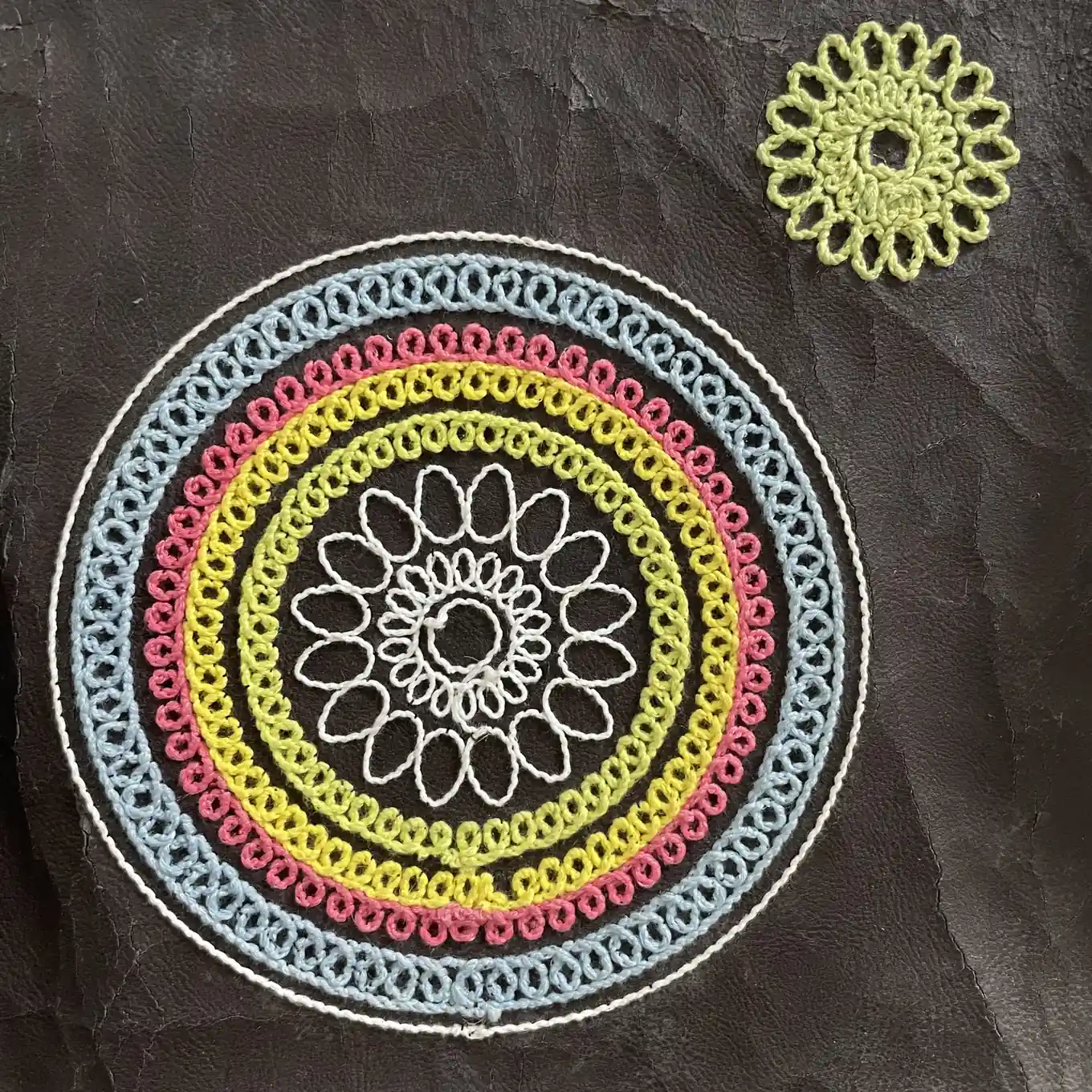
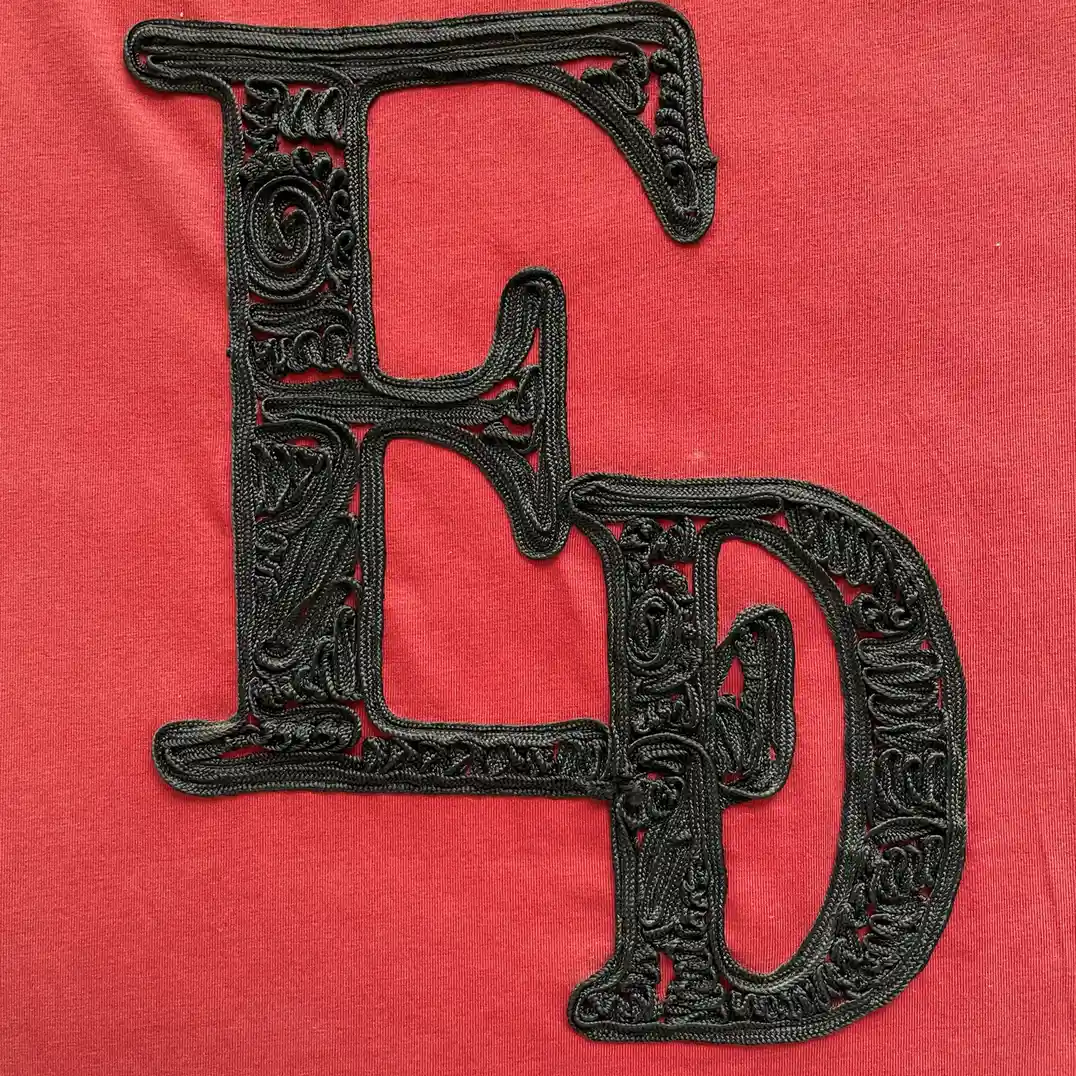
Cord embroidery is essentially fixing a cord (or webbing) along the path of a design onto the fabric so that the line itself stands raised.
It does not rely on piling up embroidery thread to create height; instead, the cord or tape becomes part of the design—so the dimensionality is tangible, the lines are rounded, and it has a handcrafted decorative feel. For raised lines in letters, badges, floral stems, and decorative borders, it is one of the commonly used techniques.
A one-sentence explanation for customers:
Cord embroidery is like “drawing” on fabric with cord—the lines are raised and have a tangible three-dimensional outline.
Names for cord embroidery vary widely, and customers use a wide range of search terms. Common names are listed below:
| Name | Description |
|---|---|
| Cord embroidery | Common term; round-section cord coiled into a design |
| Ribbon embroidery | Flat webbing / satin ribbon replaces round cord; lines are wider, flatter, and more lustrous |
| Cord work / wrapped-cord embroidery / cord-strand embroidery | Emphasizes the “cord” and “wrapped-and-tacked” structure; a common industry term |
| Wrapped-cord embroidery | A fine thread is wrapped around the cord core to create a spiral texture (higher cost) |
| Track cord embroidery / wide-band embroidery | Specifically refers to fine-cord tracking/outlining or the sub-process of 30–50 mm wide-band embroidery |
| Flat-tape embroidery / coil embroidery | Terms for flat-tape and coiled types |
| English names | Cording / Couching (the industry-standard term for laid-thread embroidery) / Braided Trim / Ribbon Embroidery |
Three concepts that must be distinguished:
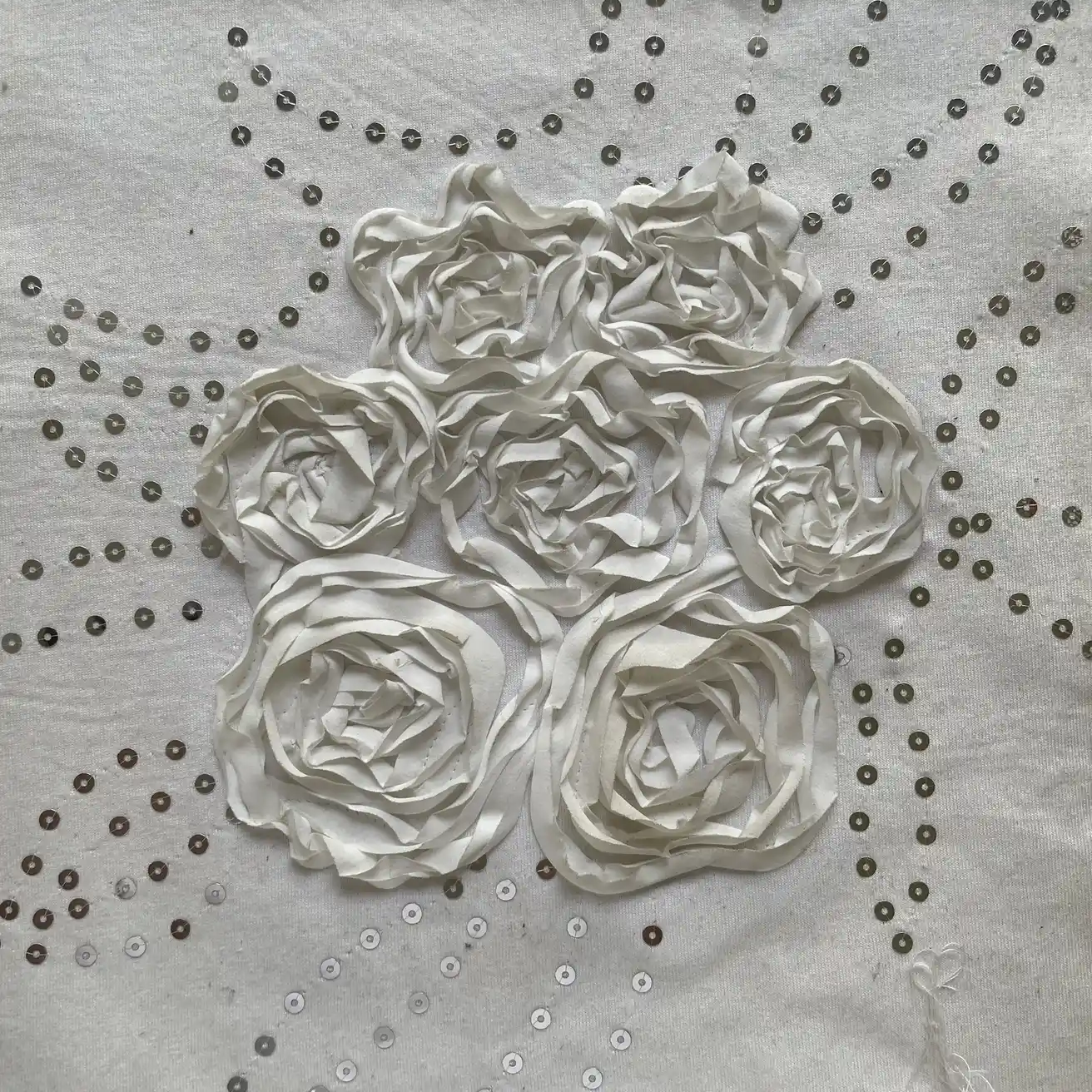
Cord embroidery is carried out by a dedicated specialty head equipped with a cord/tape feeding device:
Three common cord-laying methods: single-thread couching, double/multi-thread parallel cord laying, and wrapped-cord embroidery.
Four key control points: feed angle, feed tension, tacking method, and corner handling.
Four tacking stitch types: cross-stitch tacking (visible tack / zigzag), sawtooth tacking, hidden tacking (central invisible straight stitch; hollow round cord gives a nearly seamless relief), and coil embroidery / track cord embroidery.
Why do “corners” and “cord ends” tell you so much about a factory’s workmanship?
In lower-cost cord embroidery, corners tend to arch and bunch up, and cord ends may show on the face or unravel. Our approach uses rounded corner transitions + automatic speed reduction + fixed-point locking stitches, and all cord ends are brought to the back and heat-sealed. When reviewing a sample, turn it over and check whether the corners flow smoothly and the ends are clean; this largely tells you the factory’s craftsmanship.
| Item | Specifications & Design Recommendations |
|---|---|
| Fine cord (metallic cord, etc.) | From approx. 0.8 mm |
| Standard cord diameter | 1.0–8.0 mm (commonly 1.5–3.5 mm) |
| Flat tape / ribbon width | 2.0–9.0 mm (thickness approx. 0.3–2.8 mm) |
| Wide-tape embroidery | Up to 30–50 mm |
| Raised height | ≈ cord diameter itself, typically approx. 1.0–4.0 mm |
| Inner turning radius | ≥ 1.5–2× cord/tape width, and preferably no less than 6.0 mm |
| Minimum line width | Design recommendation ≥ 3.0 mm |
| Common tacking thread | Transparent monofilament thread for light-colored cord; matching-color matte thread for dark-colored cord |
| Pricing basis | Calculated based on actual meters of cord/tape consumed and stitch count |
| Washing & care | For daily care, hand wash or gentle wash at ≤40°C; avoid high-temperature tumble drying and high-temperature ironing |
Note: The above are standard capability ranges; actual results are subject to sampling confirmation—cord/tape specifications, number of corners, and substrate hardness all affect the 3D effect and durability. We insist on producing a physical sample first before discussing bulk production.
Style positioning: haute couture, light luxury, vintage, and China-chic—particularly suited to design-forward 3D lines and decorative outlines.
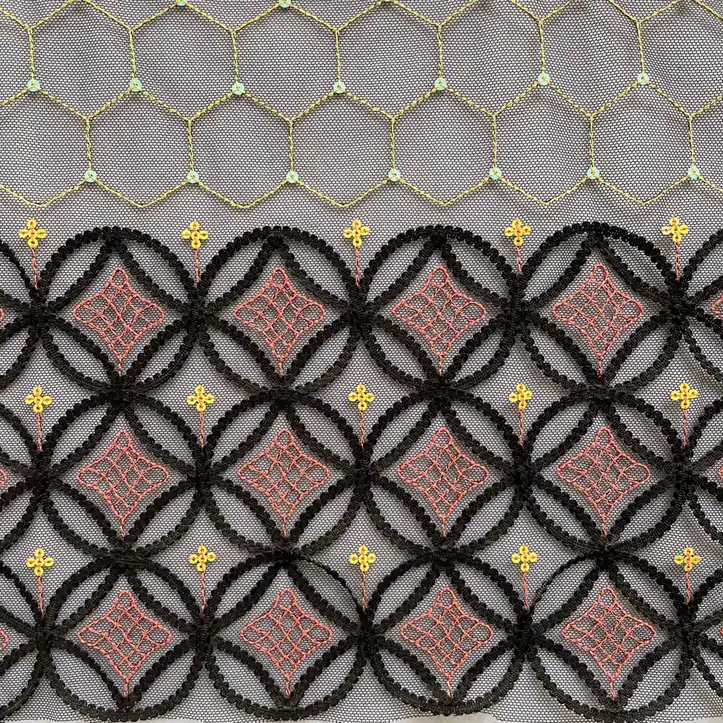
Performs well on: mainly medium-to-heavyweight fabrics—heavyweight terry sweatshirt fabric, denim, canvas, twill, thick knits, woolen fabric, leather, microfiber, etc.
Evaluate with care: extremely thin or highly elastic fabrics (confirm before pattern-making whether an additional backing is needed); fabrics with heavy coatings or water-repellent finishes (pre-test tacking stitch grip and fastness).
Suitable product categories: school uniform and uniform badges, military and workwear decorative emblems, 3D contours on wedding dresses and gowns, haute couture garment lines, bag contours and hardware accessories, shoe side lines, 3D baseball cap emblems, traditional motifs on New Chinese-style garments, home furnishings, and wallcovering murals.
Not suitable for (we will advise in advance): large solid filled areas (cord embroidery is a line technique; for large filled color areas, we recommend combining it with flat embroidery); extremely small, intricate details (tiny text below 3 mm); ultra-thin, lightweight summer close-fitting garments where a barely-there feel is desired.
| Process category | Structural form | Raised height | Visual characteristics | Typical applications | Processing cost |
|---|---|---|---|---|---|
| Cord embroidery (round cord) | Round-section cord coiled and stitched | ≈ cord diameter (1.0–4.0 mm) | Rounded and dimensional; strong handcrafted decorative feel | Badges, gown silhouettes, bags, Chinese-trend (Guochao) motifs | Medium-high |
| Ribbon embroidery (flat tape) | Flat woven tape / layered satin ribbon | ≈ tape width (flat relief) | Wide lines with satin sheen | Border decoration, wide-line lettering, ribbon florals | Medium-high |
| Wrapping embroidery | Twisted wrapping thread over a cord core | Relatively high (with spiral raised texture) | Spiral texture; heavy couture-like texture | Haute couture runway garments, artistic garment details | High |
| Flat metallic thread embroidery | Flat-laid metallized film | Near-zero height (flat) | Reflective sparkle; metallic luster | Bright-line outlines, logo edging, metallic decoration | Medium-high |
| Standard flat embroidery outlining | Parallel embroidery-thread stitches | Near-zero height (slightly raised) | Smooth and fine; light and conforming | Standard outlines, fine small lettering, large areas at low cost | Low |
One-line selection guide: For raised outlines with a handcrafted decorative feel → choose cord embroidery; for satin sheen and wide-edge relief → choose ribbon embroidery; for sparkling metallic lines → choose flat metallic thread embroidery; for flat, low-cost lines → choose standard flat embroidery outlining.
Q1 | What is the difference between cord embroidery and standard embroidery outlining?
Standard outlining uses the embroidery thread itself and has almost zero height; cord embroidery stitches down an actual braided cord or woven tape, and the raised height is basically equal to the cord thickness. If you need dimensional raised lines with a handcrafted braided feel, cord embroidery is the appropriate choice; if you need flat lines or cost control, standard flat embroidery is sufficient.
Q2 | How should I choose between round cord and flat ribbon?
For rounded, full dimensional lines, choose round cord; for wide lines with satin sheen or a vintage tape texture, choose flat ribbon. Round cord gives a thicker raised effect, while flat ribbon is flatter and smoother. We can recommend materials based on your artwork style and provide comparison samples.
Q3 | What is the finest line you can produce? Can you do large-area solid filling?
For single lines, ≥ 3 mm is recommended; extra-fine metallic cord can go down to 0.8 mm. Cord embroidery is a line-decoration technique and is not suitable for large-area solid color filling—if you need large color blocks, we recommend flat embroidery, appliqué, or digital printing as a base, with cord embroidery for outline finishing.
Q4 | Will cord ends show, or will they unravel or come off during washing?
In our bulk production process, cord ends are brought to the back of the fabric and secured with spot lock stitches and hot-melt sealing; the front is flat and clean, and the finish resists unraveling or detaching in normal wear. Washing recommendation: hand wash or gentle machine wash at ≤40°C; avoid high-temperature ironing.
Q5 | How are MOQ, sampling, and lead time arranged?
MOQ is 300 pieces; free sampling for 3 simple designs; complex sampling fees are credited when the order reaches MOQ; sampling takes 24–48 hours, and bulk lead time is 5–10 business days. Send vector artwork (AI/PDF) + target fabric + desired cord or ribbon specifications and quantity, and process costing can usually be completed within half a day.
Dongguan Dobest Industrial Co., Ltd. (Dobest) — established in 2013, specializing in computerized embroidery processing and custom specialty embroidery. Our main processes are toothbrush embroidery and chenille embroidery, and we are experienced in more than 50 types of specialty embroidery, including cord embroidery, ribbon embroidery, and backing-free embroidery. We have more than 30 specialized computerized embroidery machines (including 15 dedicated toothbrush embroidery machines), with an annual capacity of 1.5 million pieces. We support on-site consultation and rapid sampling.
Phone/WeChat: 13712297700 | Website: dobest.hk | Online Inquiry and Sampling
We can provide on-site consultation to customers in Dongguan, Shenzhen, Foshan (including Shunde), Zhongshan, Guangzhou, Zhuhai, Huizhou, Jiangmen, and other Pearl River Delta cities. For Guangzhou urban area and surrounding districts (Haizhu, Liwan, Tianhe, Baiyun, Huangpu, Panyu, Huadu, Nansha, Conghua, Zengcheng) and local Dongguan towns and subdistricts (Humen, Houjie, Chang'an, Dalang, Changping, Dalingshan, Shipai, Chashan, Tangxia, Liaobu, Dongcheng, Nancheng, Wanjiang, etc.), we can usually visit within half a day.
For sampling inquiries, we recommend sending the following directly: ① artwork file (AI/PDF/high-resolution image) ② fabric type to be used ③ desired cord/ribbon specification (round cord/flat tape) ④ quantity and lead time — when all four are provided, quotation and sample production will be faster.

Hotline / WeChat:
137-1229-7700 2/F, Bldg E, Jinmao Xincheng, No.7 Jiedong South Rd, Xiaojiejiao, Humen, Dongguan, Guangdong, China Phone: 0769-81517903
 mclau@dobest.hk
Hotline:
13712297700
0769-81517903