Technical Articles
article current location: Home > Technical Articles
 Release time:2026-10-16
 page views:
[Core Definition and Quick Selection] Flat metallic thread embroidery (Metallic Thread Embroidery, also called gold-thread embroidery or gold couching) uses narrow flat strips of metallized film laid flat for embroidery. When stitch direction is uniform, it creates a continuous mirror-like reflection, lies flat and smooth without twisting or flipping, and is well suited to lines, borders, and lettering. MOQ from 300 pcs; free samples for 3 simple designs; sampling in 24–48 hours; bulk production in 5–10 working days. Suitable for Chinese-style formal garments, formal gowns, accessible-luxury branding, and premium badges.
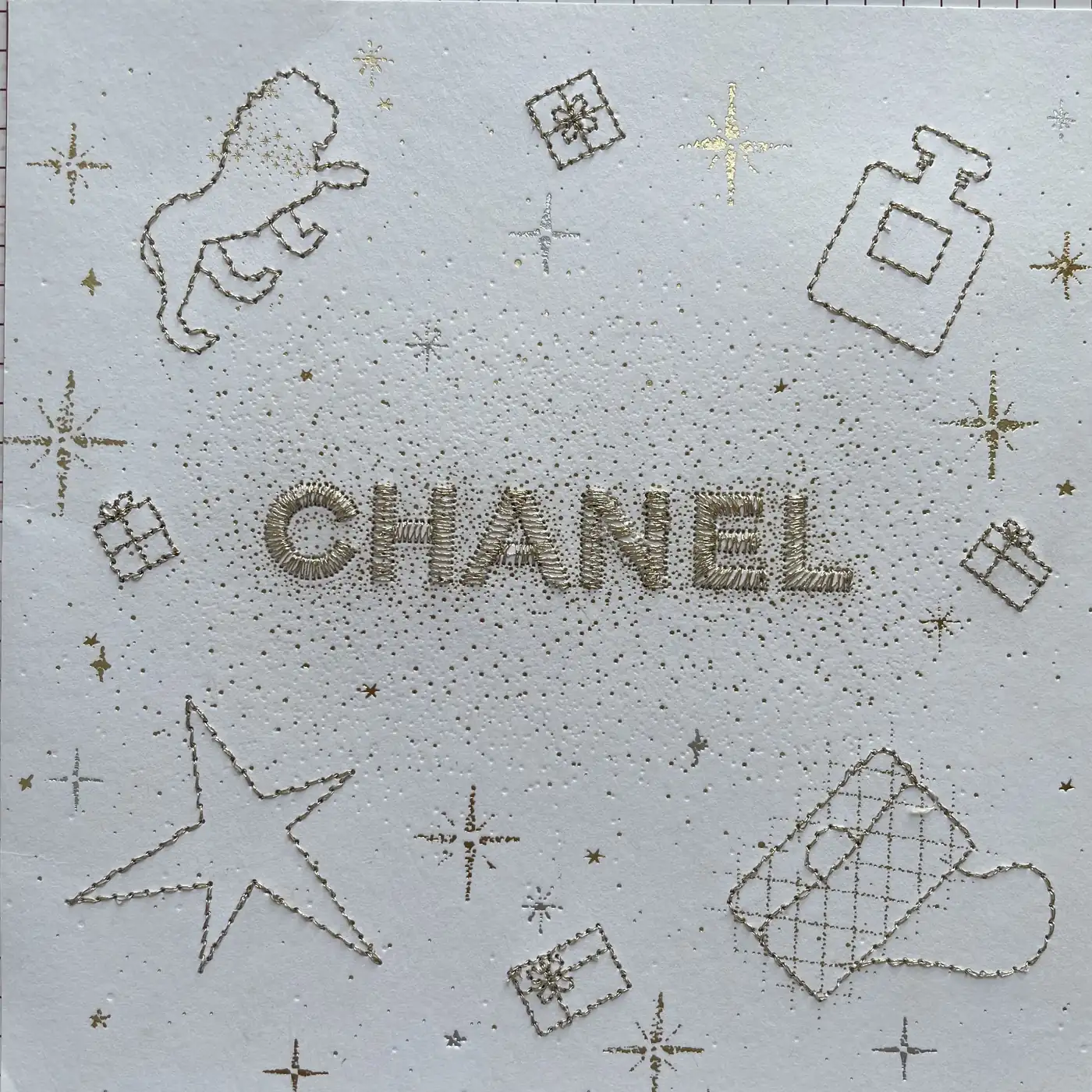
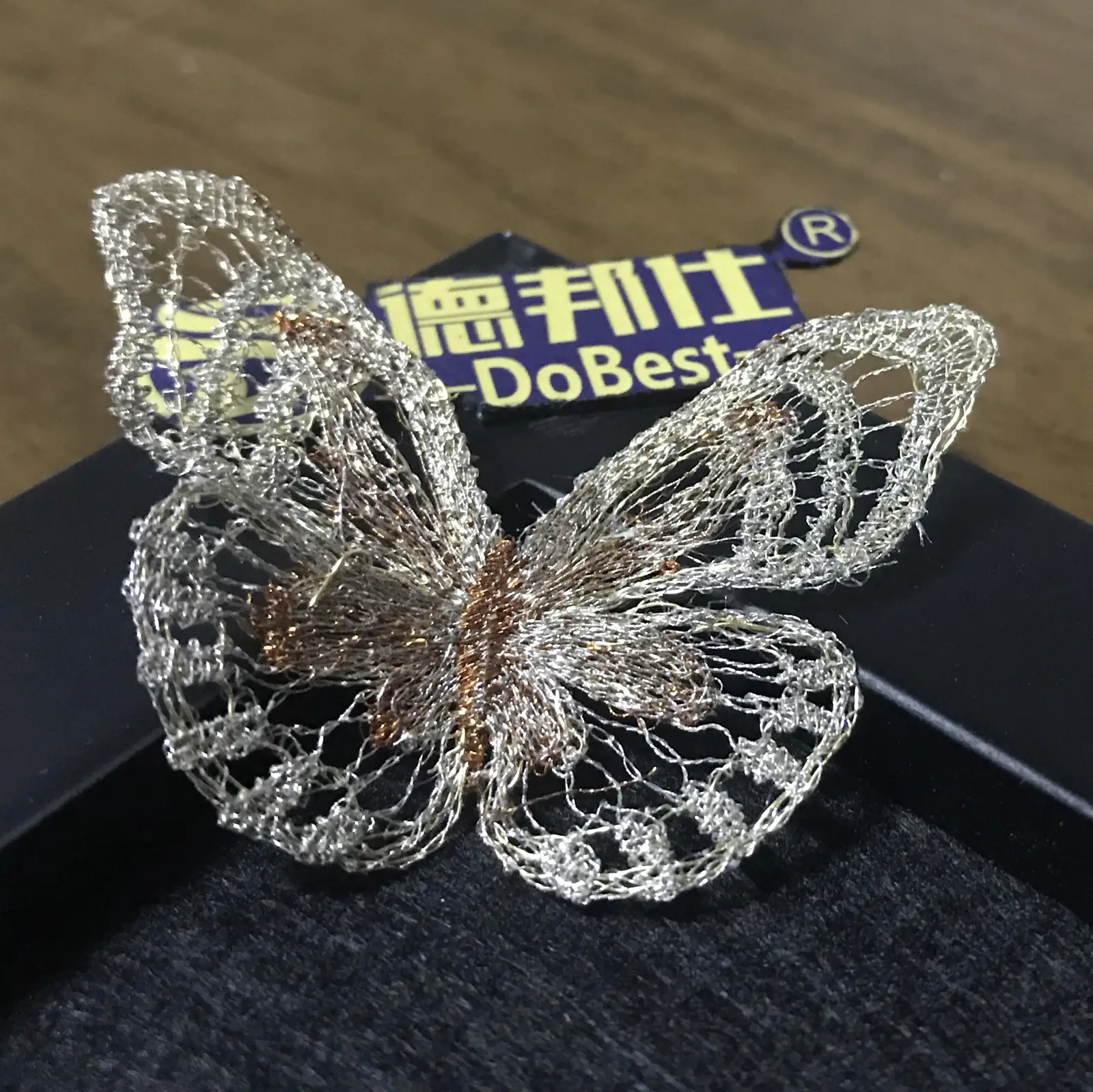
Flat metallic thread embroidery uses genuinely reflective metallic thread, not ordinary embroidery thread dyed yellow: it lays very thin, narrow strips of metallized film flat across the fabric surface to create a continuous, full-area mirror-like reflection. As light hits from different angles, the brightness shifts and flows—an effect ordinary cotton or polyester threads cannot achieve.
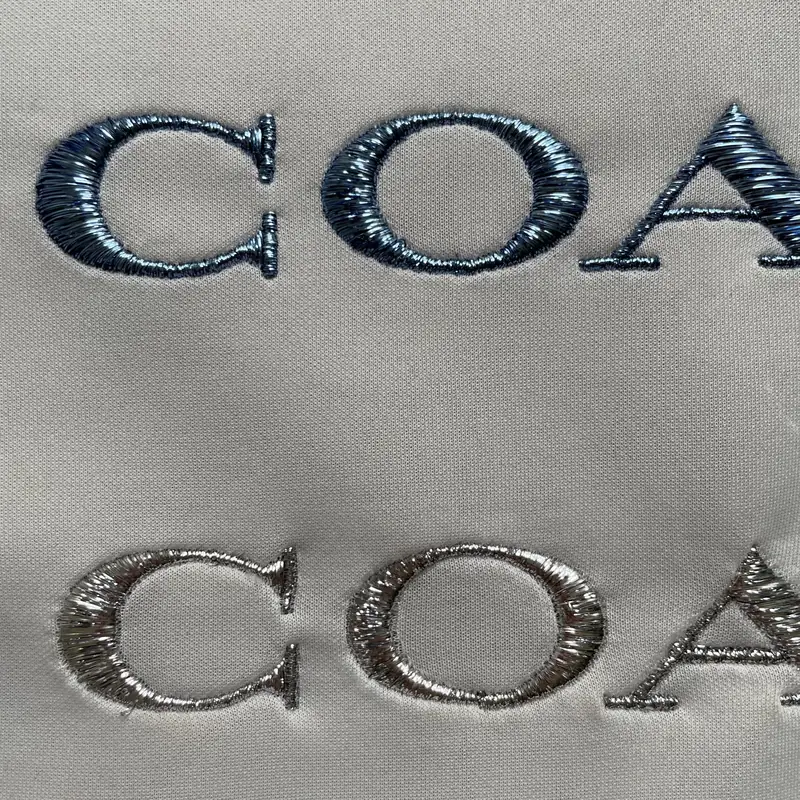
Stitch a gold letter onto a black cashmere coat or formal gown, and the luxurious feel of the whole garment immediately comes through. Flat metallic thread supports premium pricing and perceived quality, rather than decoration alone. Unlike the scattered, star-like glints of conventional round-core wrapped metallic thread, it is closer to the broad mirror-like sheen of a polished precious-metal plate.
Ordinary metallic thread embroidery means yellow thread stitched on, with scattered points of light; flat metallic thread embroidery means thin metal strips laid flat, with full-surface mirror reflection.
In apparel sourcing and export communication, there are many trade terms and names for “metallic-luster embroidery,” and the same requirement may be called different things:
| Industry term | English equivalent | Origin and focus |
|---|---|---|
| Flat metallic thread embroidery / machine flat metallic thread embroidery | Flat Metallic Thread Embroidery | The most precise technical term, directly referring to flat ribbon-like thread and computerized machine embroidery. |
| Metallic thread embroidery / Lurex embroidery / shiny-thread embroidery | Metallic / Lurex Embroidery | Named for the look of reflective metallic thread; the most widely used term in the industry and the one clients are most likely to mention. |
| Gold couching | Gold Couching | A term inherited from the traditional hand-embroidery technique of couching thread in place; now often used broadly for machine metallic thread embroidery. |
| Metallic thread embroidery / metallic foil-strip thread embroidery | Metallic Film Stitching | Emphasizes the metallized film structure of the thread; common in technical documents and English-language inquiries. |
Two process boundaries that need to be clarified:
Flat metallic thread is much more brittle than polyester thread and prone to break at bends. It is highly sensitive to needle friction, sharp edges in the thread path, and tension fluctuations. Running flat metallic thread directly on a standard embroidery machine can lead to thread-breakage rates too high for volume production. Dobest has made dedicated preparations in machine configuration and digitizing algorithms for such difficult threads, centered on four points:
| Process Control Item | Standard Capability Metrics | Design and Engineering Notes |
|---|---|---|
| Flat thread specifications | Thickness approx. 10–25 microns, width approx. 0.3–0.8 mm | The wider the thread, the greater the coverage and the more prone it is to flipping; use with a thread feed device. |
| Material types | Three grades: metallized film flat thread, core-wrapped metallic thread, imitation glitter thread | Gloss and durability tend to be inversely related; select among the three grades based on product positioning. |
| Minimum line width | Recommended ≥ 1.5 mm | Flat thread has an inherent width; lines that are too fine can look bulky and are prone to flipping, so a finer-thread option is required. |
| Minimum letter height for English letters | Recommended ≥ 8 mm | At 8 mm and above, letter edges are clear, corners are less prone to thread breakage and sticking. |
| Stitch density | The stitch file should be relatively open, with longer stitches and minimal overlap | Excessive overlap can scratch the metallic film and unnecessarily increase cost. |
| Maximum embroidery field per design | Standard 400 mm × 400 mm | Supports front-chest main logos, large back graphics and large full-coverage mirror-like areas. |
| Washing, care and weathering standards | Dry clean or gentle hand wash recommended; iron at ≤ 130℃ with a pressing cloth | Avoid mechanical abrasion from machine washing and high-temperature damage to the metallic film; see delivery notes for details. |
Core advantages (Pros):
Process boundaries and physical limitations (Cons):
Common garment placements and recommended sizes:
Recommended base fabrics: Medium-to-heavyweight fabrics with uniform density work well, such as heavyweight sweatshirt fabric, woolen, vintage raw denim, heavy canvas, silk satin and cashmere coating fabric; dark base fabrics (black, navy, burgundy) better highlight the metallic shine, while light-colored bases look fresher.
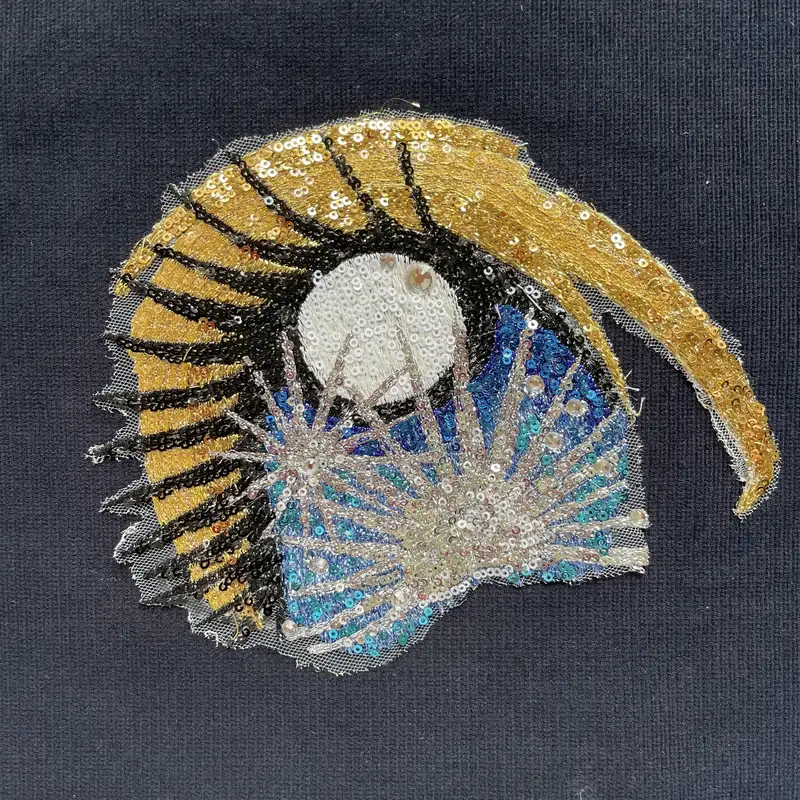
Flat metallic thread can be used independently for lines, borders and letters, and can also be cross-combined with a range of techniques; using several techniques in one design often makes it more striking:
When combining, plan the stitching order and areas for each technique in advance to avoid hard materials such as sequins and beads rubbing against and scratching the metallic thread in the same area during embroidery.
| Technique category | Dimensional and texture profile | Hand feel | Minimum line width | Best-fit styles | Relative cost |
|---|---|---|---|---|---|
| Flat metallic thread embroidery | Flat and closely conforming, continuous mirror-like sheen | Smooth, subtle metallic feel | Approx. 1.5 mm | Lines, borders, lettering, badges | High |
| Sequin embroidery | Dot-matrix sequin reflection, medium dimension | Grainy; prone to snagging | Medium | Large shimmering surfaces | Medium-high |
| Beading | Point refraction, medium-high dimension | Hard, bead-like grain | Medium-high | Highlight accents | Medium-high |
| Foil stamping print | Flat-laid, no dimension | Smooth against the skin | Low | Low-cost large areas | Low |
| Standard flat embroidery | Flat stitching | Soft | Under 1 mm | Everyday labels and lettering | Low |
One-line memory aid: metallic thread carries the luxury on the "lines", sequins carry the sparkle on the "surfaces"; for a formal, serious metallic effect, choose flat metallic thread on a dark ground as a fully filled solid block; for understated accents, use fine flat metallic thread for lines and outlines.
Q1 | Will flat metallic thread embroidery oxidise and turn dark?
Some metallic threads containing silver or copper can oxidise and darken after prolonged exposure, moisture or contact with perspiration. For products intended for long-term use or frequent laundering, we suggest oxidation-resistant film-type or metallic-look threads, along with damp-heat and light ageing tests at the sampling stage; care recommendations will be set out clearly in our delivery documentation.
Q2 | Can it be washed? Will colours fade or the surface scratch?
Metallic film threads are sensitive to the mechanical abrasion of machine washing, to high temperatures and to strongly alkaline detergents; dry cleaning or gentle hand washing is recommended, and fibres are less likely to shed after washing. Film-type metallic thread has a delicate surface and can lose its sheen when rubbed against hard objects, so we use low-friction thread-path components, dedicated needles and optimised stitching paths to avoid scratching during production; in use, please also avoid rubbing against sharp objects.
Q3 | How fine a line can you produce? Can you do small letters?
Flat metallic thread has an inherent width, so extremely fine lines tend to look bulky. For a fine-line effect we would suggest a finer metallic thread or a combination with flat embroidery; this needs to be confirmed at the design stage, rather than reworked after sampling.
Q4 | Will it irritate the skin when worn next to the body?
Premium ultra-thin flat metallic thread is lighter and softer than ordinary polyester thread, with a smooth, closely conforming surface. For next-to-skin products we would suggest a flat back finish or a soft backing to avoid any foreign-body sensation.
Q5 | Why is flat metallic thread embroidery more expensive than standard embroidery?
Because machine speeds must be reduced, thread-break waste has to be factored in, the thread itself costs more, and the machines require dedicated configuration and maintenance. These are real costs; in our quotation we set out three thread grades so customers can choose according to their positioning — a higher price does not automatically mean a better match.
Dongguan Dobest Industrial Co., Ltd. (Dobest) was founded in 2013 and has focused on the development and manufacture of specialty computerised embroidery for 13 years, with a 3,000 ㎡ modern production workshop and more than 30 specialty embroidery machines. We have passed Disney ILS and adidas SEA factory audits and have held an A-grade taxpayer credit rating for four consecutive years. Raw materials come with OEKO-TEX® Standard 100 and SGS test reports from our suppliers, and we can accommodate customer-specified testing on request.
Service Hotline / WeChat: 13712297700 | Official website: dobest.hk | Submit a sampling request online
For customers in the Pearl River Delta, we provide on-site consultation services covering Dongguan, Shenzhen, Foshan (including Shunde), Zhongshan, Guangzhou, Zhuhai, Huizhou, Jiangmen, and other cities. For Guangzhou’s main urban area and surrounding districts (Haizhu, Liwan, Tianhe, Baiyun, Huangpu, Panyu, Huadu, Nansha, Conghua, Zengcheng) and local Dongguan towns/subdistricts (Humen, Houjie, Chang'an, Dalang, Changping, Dalingshan, Shipai, Chashan, Tangxia, Liaobu, Dongcheng, Nancheng, Wanjiang, etc.), in most cases we can visit within half a day to discuss samples.

Hotline / WeChat:
137-1229-7700 2/F, Bldg E, Jinmao Xincheng, No.7 Jiedong South Rd, Xiaojiejiao, Humen, Dongguan, Guangdong, China Phone: 0769-81517903
 mclau@dobest.hk
Hotline:
13712297700
0769-81517903