Technical Articles
article current location: Home > Technical Articles
 Release time:2026-10-15
 page views:
[Core Definition and Quick Selection Guide]Machine bead embroidery (computerized beading / machine-sewn beading / bugle bead embroidery / seed bead embroidery) is a continuous bead-feeding machine embroidery process. It uses a special computerized embroidery machine’s dedicated automatic bead-feeding guide rail and synchronized needle-feeding mechanism to precisely lock-stitch colored glass seed beads and metal bugle beads one by one onto the fabric surface. The core technology lies in “CNC bead-by-bead placement and micro independent locking knots on the reverse.” Needle concentricity tolerance is controlled within ±0.05mm, the bead arrangement is dense and flat, and if a single bead’s thread breaks, chain-style unraveling and bead loss are unlikely. It combines the brilliant refractive luster of couture hand beading with the high-efficiency consistency of modern CNC mechanization. It is widely used in high-end streetwear hoodies, evening gowns, stage costumes, and labels for bags, footwear, and headwear. Dongguan Dobest source factory is equipped with more than 30 specialty computerized embroidery machines. Standard MOQ starts at 300 pieces; free sampling is available for 3 simple designs, sampling takes 24–48 hours, and bulk production takes 5–10 working days. We support R&D and custom development from drawings and samples.
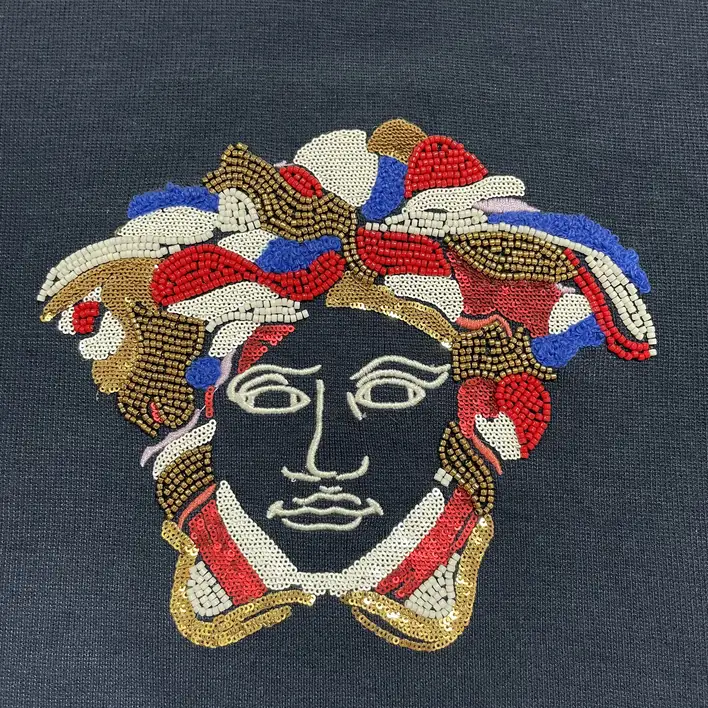
If you need to explain computerized bead embroidery clearly to buyers and apparel designers in one sentence: “Machine bead embroidery fixes real jewelry-grade materials onto fabric bead by bead—it does not use embroidery thread to imitate shine; it directly builds physical luster and three-dimensional tactile quality with high-refractive glass or tiny metal beads.”
Traditional flat embroidery reflects light through the density of thread arrangement, while machine bead embroidery relies on the specular refraction and crystal translucency of three-dimensional materials. Under spotlights or everyday light, as the wearer moves and the viewing angle changes, bead surfaces display a flowing starlit sparkle, delivering a distinctive sense of luxurious volume and highly recognizable visual impact.
In international buyers’ purchase orders and domestic apparel patternmaking communication, beading processes often involve overlapping and confusing terminology. We systematically clarify them in the table below:
| Language / Name | Primary Term | Industry Aliases and Related Terms | Process Structure and Key Differences |
|---|---|---|---|
| Simplified Chinese | Machine bead embroidery | computerized beading, machine-sewn beading, bugle bead embroidery, loose-bead machine embroidery | Dedicated bead-feeding head dispenses beads; specialized fine high-strength thread passes through and locks the base; strong hold, uniform beads, suitable for mass production |
| Traditional Chinese | Machine bead embroidery | computerized beading, machine-sewn beading, bead embroidery, seed bead machine embroidery | Common term in Hong Kong, Taiwan, and export orders; generally refers to automated mechanized bead-string embroidery |
| English | Beaded Embroidery | Machine Bead Embroidery, Bugle/Seed Beading | Common international sourcing term; subcategories include Seed Beads and Bugle Beads |
| Easily Confused: Hand Beading | Hand Beading | hand-sewn beading, couture French embroidery (Lunéville) | Purely manual single-needle sewing; highly flexible but with long lead times, high unit cost, and lower batch consistency |
| Easily Confused: Hot-fix Rhinestones | Hot-fix Rhinestones | hot-fix stones, octagon rhinestones, hot-melt adhesive-back rhinestones | Bonded to the fabric surface by hot pressing an adhesive backing; no thread passes through; wash durability is lower than machine-sewn beading |
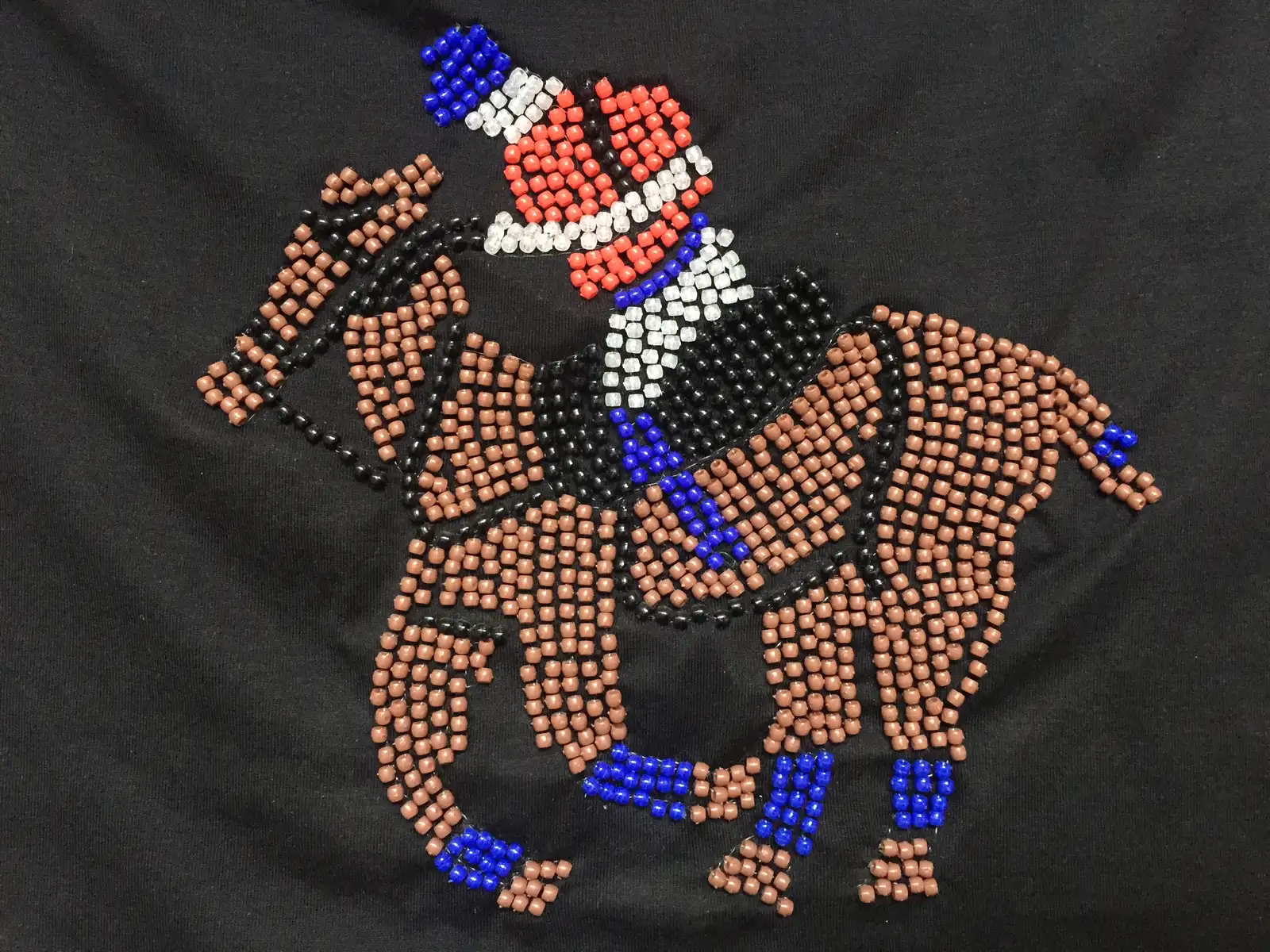
Key Terminology Difference Reminder: In overseas Tech Packs, Seed Beads refers to round/oval “round seed beads” (typically 1.5–3.0mm outer diameter), suitable for large-area full coverage or gradient color-block filling; Bugle Beads refers to “long bugle beads” (2.0–10.0mm length), which offer strong axial reflection and line-guiding quality, suitable for outlining upright stems, letter structures, or geometric radial patterns. Choosing the wrong bead type can completely shift the overall garment style and cost away from expectations.
Computerized bead embroidery is not a manual operation; it is a concentrated expression of modern precision mechatronics:
To give brand apparel buyers and product developers clear data references when creating design drafts, Dobest has compiled the following core parameter range table for machine bead embroidery:
| Parameter | Standard Capability Range | Recommended Ideal Range | Process Notes & Sampling Recommendations |
|---|---|---|---|
| Seed Bead Diameter (Seed Beads) | 1.5 mm – 4.0 mm | 2.0 mm – 3.0 mm | If too small (<1.5 mm), machine needles may crush them; if too large (>4.0 mm), the garment may feel noticeably heavy |
| Bugle Bead Length (Bugle Beads) | 2.0 mm – 10.0 mm | 3.0 mm – 6.0 mm | Bugle beads suit straight lines or large-curve contours; overly long bugle beads tend to lift at tight corners |
| Bead Hole Inner Diameter | ≥ 0.6 mm | 0.7 mm – 0.9 mm | Compatible with #9–#11 specialty beading needles, allowing high-strength silk thread to pass smoothly |
| Single-Panel Embroidery Area | 10×10 mm to 500×400 mm | 80×80 mm to 300×250 mm | Supports chest logos, arm patches, large back designs, and cut-piece embroidery on continuous fabric |
| Base Fabric Weight Support | 120 g/m² – 650 g/m² | 220 g/m² – 450 g/m² | Lightweight fabrics (such as chiffon and silk) require water-soluble backing reinforcement to reduce pulling and wrinkling |
| Bead-Loss Prevention Structure | Digital micro-locking knots on the reverse | Independent multi-node locks across each unit | Cutting a single bead does not affect adjacent beads, supporting high garment durability |
| MOQ & Sampling | MOQ from 300 pcs | Sampling in 24–48 hours | 3 simple samples provided free; R&D sampling supported based on drawings and supplied samples |
Objectively and clearly assessing process characteristics is key for experienced apparel buyers to make precise decisions:
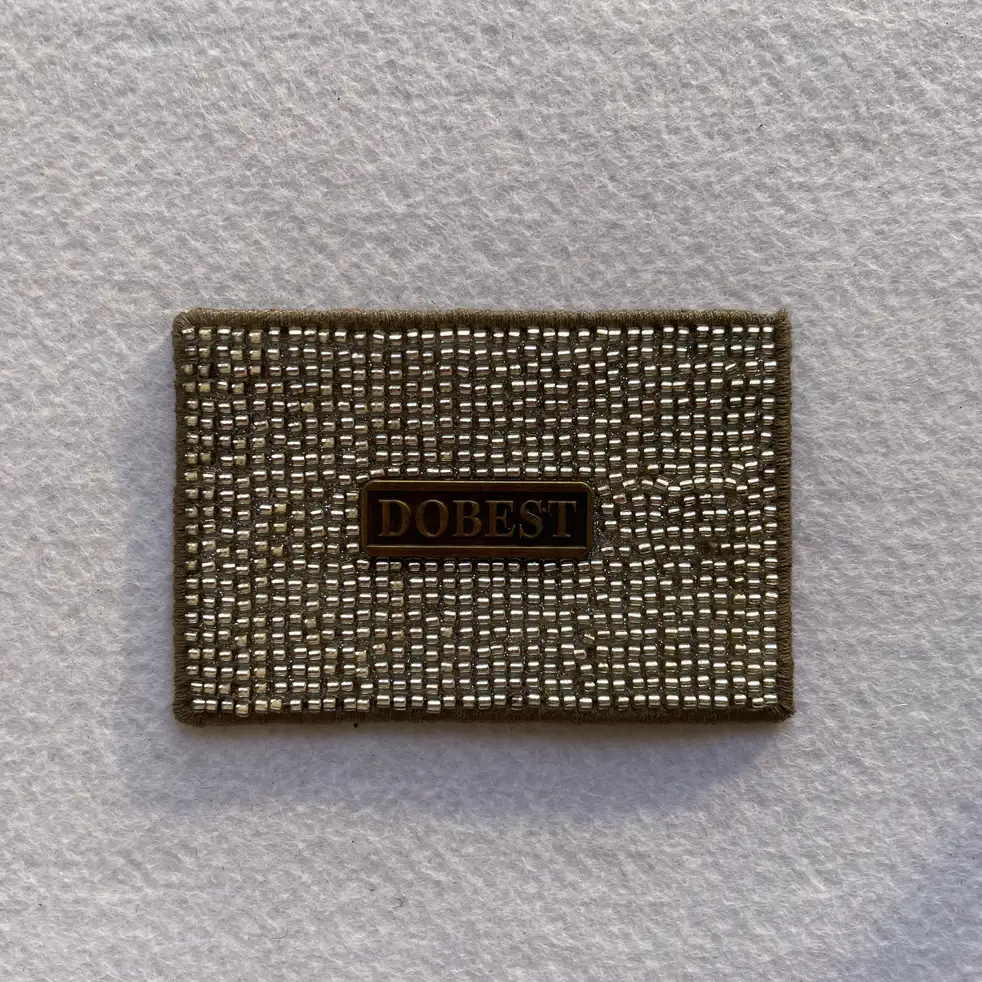
Placement of bead embroidery on different garment areas should balance visual appeal and ergonomic comfort in motion:
In high-end designer brands and hit streetwear development, computerized beading is rarely used alone — it is often combined with other specialty techniques:
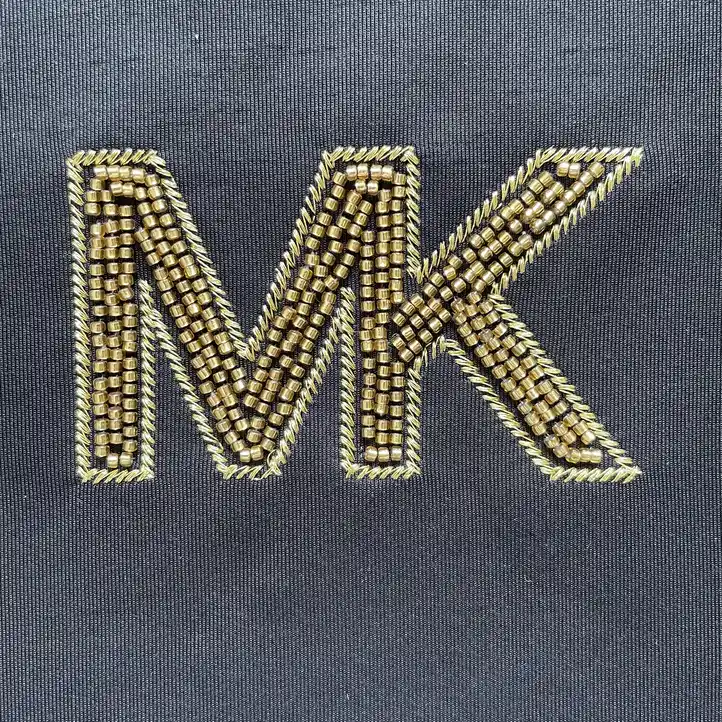
For common lustrous, three-dimensional embroidery techniques, the table below offers a side-by-side comparison across all dimensions:
| Comparison | Computerized Beading | Sequin Embroidery | Hot-Fix Rhinestone Application | Cord Embroidery (Thick-Thread Couching) |
|---|---|---|---|---|
| Three-dimensional effect | ★★★★☆ (round beads plump, tube beads upright) | ★★☆☆☆ (flat, overlapping fish-scale layers) | ★★★☆☆ (faceted conical raised form) | ★★★★☆ (thick, relief-like cord) |
| Lustre and expression | Refined pearlescent sheen, multi-angle refraction | Strong mirror reflection, bright sparkle | Concentrated point highlights, rhinestone sparkle | Matte cotton-like or metallic thread sheen |
| Wash durability | Excellent (stitched through with fine thread, micro knots) | Excellent (individually or chain-stitched in place) | Good (glue-backed; may loosen in high-temperature washing) | Very good (double-reinforced stitching) |
| Hand feel | Firm with slight granulation, noticeable weight | Smooth and slightly stiff, scale-like when handled | Hard raised feel, stiffer backing fabric | Supple and elastic, warm to the touch |
| Suitable categories | Couture streetwear hoodies, gowns, jackets | Performance wear, women's T-shirts, cushions and bags | Fast-fashion womenswear, sports apparel accents | Denim jackets, hoodie lettering, vintage workwear |
| Production cost | Medium-high (relies on precision machine heads and dedicated bead materials) | Medium (fast sequencing, mature materials) | Medium-low (efficient layout and laser heat pressing) | Medium (specialty cord-feeding equipment) |
When supplying computerized beading artwork or a Tech Pack to the factory, please pay close attention to the following engineering details:
As a source factory specializing in specialized computerized embroidery, Dobest offers the following commercial cooperation standards:
Q1 | How should machine-beaded garments be washed in daily use? Will washing cause bead loss or loose threads?
During digital digitizing, Dobest machine beading uses dense miniature independent lock stitches on the reverse side, so wear on a single bead is less likely to cause a chain of loose threads or bead loss. For regular machine washing, turn the garment inside out, place it in a laundry bag, and use a gentle cycle at 30–40°C or gentle hand wash. After washing, hang to dry naturally in the shade; avoid prolonged high-temperature tumble drying and vigorous high-speed spin. When ironing, place a cloth over the reverse side and iron at low temperature, avoiding direct contact with hard beads on the face side.
Q2 | What are the differences in appearance and texture between machine beading and hand beading?
Machine beading is stitched by CNC machines. Its main advantages are very dense and neat bead placement, highly smooth and even lines, and consistent repeatability across thousands of bulk pieces, making it suitable for industrial production of modern high-end fashion; hand beading has relatively random and looser stitches and is often used for one-off runway heavy-work couture. Modern high-end machines can combine flat-lay, overlap, and bugle and seed bead direction to achieve a couture-level pearlescent texture comparable to handwork, while significantly shortening production lead time.
Q3 | Can lightweight fabrics (such as summer T-shirts and silk dresses) be machine-beaded?
Yes, but process design should be tailored. Lightweight fabrics cannot support overly heavy, large-area dense bead coverage; we usually use lightweight solutions such as line outlines, scattered dot patterns, and fine metallic thread or flat embroidery support; at the same time, a special high-breathability water-soluble thin backing is added to the reverse side of the embroidery. After the embroidery is set, excess backing is removed through gentle washing, so the finished garment retains a light drape with minimal local wrinkling or dimpling.
Q4 | Do you support specially customized beads (such as ceramic beads, natural shell beads and colored irregular bugle beads)?
Yes. Dobest has a long-term stable supply chain for high-end bead materials and regularly stocks thousands of specifications, including eco-friendly electroplated metal bugle beads, iridescent glass seed beads and semi-transparent amber beads. For special development requirements, as long as the bead size and hole diameter of each batch meet the tolerances of the automatic bead-feeding rail (hole diameter recommended ≥ 0.7 mm), we can support custom tooling or sample adjustment for machine trials.
Q5 | What files do you need from us before sampling and mass production?
Customers are requested to provide clear vector design source files (AI, PDF or high-resolution CDR) and mark on the artwork the physical length and width dimensions (mm), desired bead type (seed beads/bugle beads) and intended fabric type. If the customer has a benchmark garment or fabric swatch, please courier it to our factory; our engineering team will complete precise digitizing analysis within half a day and quickly produce a sample.
Dongguan Dobest Industrial Co., Ltd. (Dobest) was founded in 2013 and has a plant area of more than 3,000 square meters. We specialize in the R&D and customization of specialized computerized embroidery and haute couture embroidery. The workshop is equipped with more than 30 specialized computerized embroidery machines (covering combined models for computerized beading, chenille embroidery, toothbrush embroidery, laser-cut embroidery and ribbon embroidery), with annual capacity of over 1.5 million pieces. The company has been rated an A-level taxpayer for four consecutive years, holds two utility model patents, and has passed the Disney ILS and adidas SEA factory audit standards.
Pearl River Delta Rapid Response Service Network: Based in Humen, Dongguan, a renowned apparel town, Dobest can visit customers in the core textile and apparel industrial belts of the Pearl River Delta, including Dongguan, Shenzhen, Foshan (including Shunde), Zhongshan, Guangzhou, Zhuhai, Huizhou and Jiangmen. In the Guangzhou urban area and surrounding areas (Haizhu Zhongda business district, Panyu Nancun apparel base, Baiyun, Liwan, Tianhe and Huadu) as well as Dongguan’s local towns and streets (Humen, Chang’an, Houjie, Dalang knitwear base, Changping, Liaobu and Nancheng), our technical staff can usually visit with physical sample cards within half a day to discuss, verify design techniques on site and respond quickly to sampling lead times!

Hotline / WeChat:
137-1229-7700 2/F, Bldg E, Jinmao Xincheng, No.7 Jiedong South Rd, Xiaojiejiao, Humen, Dongguan, Guangdong, China Phone: 0769-81517903
 mclau@dobest.hk
Hotline:
13712297700
0769-81517903