Technical Articles
article current location: Home > Technical Articles
 Release time:2026-10-15
 page views:
【Core Definition and Quick Selection】Backing-free embroidery (Backing-free / Stabilizer-free Embroidery; also called stabilizer-free embroidery, backing-free stitching, zero-film embroidery, close-fitting flexible embroidery, and pure-thread 3D embroidery) is a flexible specialty embroidery process independently developed and commercialized by Dobest in 2026. The entire embroidery process requires no paper backing (non-woven backing paper), water-soluble film, or hot-melt adhesive film; no auxiliary material residue remains on the garment back, helping reduce scratchiness and hard patches. The embroidery is flexible and close-fitting, breathable and heat-dissipating, and is less prone to thread breakage and yarn rupture when high-stretch fabrics are stretched. As a source factory, Dobest supports an MOQ of 300 pieces, standard sampling in 24–48 hours, complex combination samples in 3–4 working days, three simple sample styles free of charge, and bulk production in 5–10 working days. It is particularly suitable for direct embroidery customization of premium babywear, close-fitting T-shirts, underwear and loungewear, yoga and activewear, and light-luxury high-stretch garments.
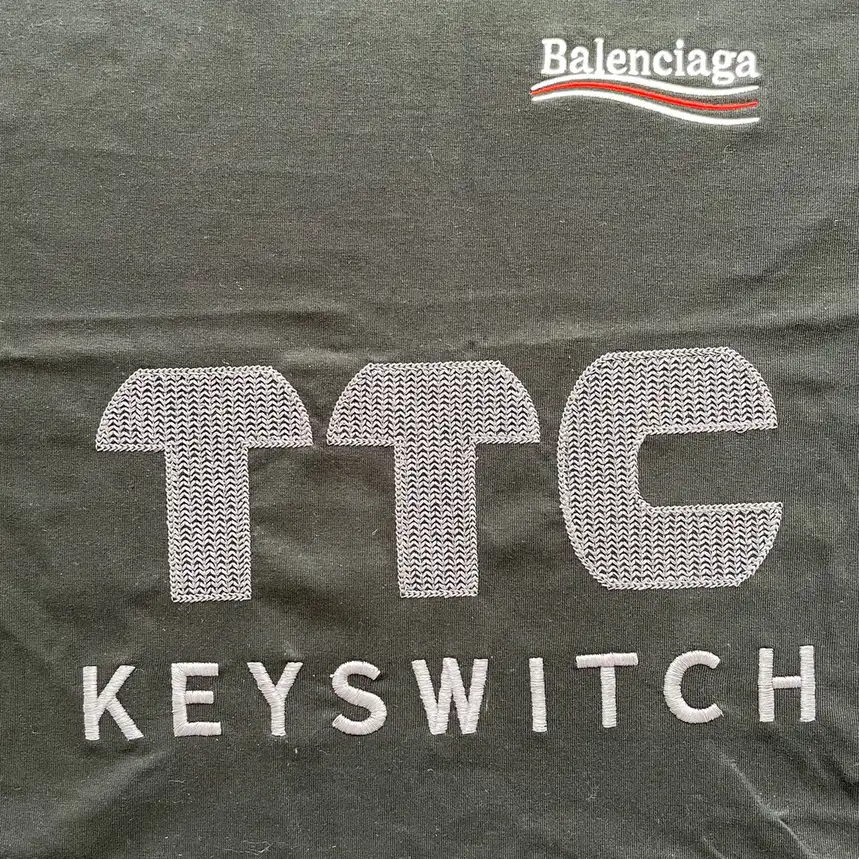
Backing-free embroidery is a skin-friendly embroidery process that “uses the embroidery thread itself to build the structure”: when the embroidery machine stitches, no backing paper, paper stabilizer, or hot-melt film is placed underneath, and the piece is the final product when it comes off the machine. The front has a dimensional, shaped appearance, while the back is made purely of soft embroidery thread. It feels as soft and breathable as the garment fabric and helps avoid scratching the skin.
For decades, the convention in traditional machine embroidery has been “no backing, no embroidery”—a layer of hard paper backing is needed to support the fabric and prevent distortion, but this brings industry pain points such as itching and scratching, hardening after washing, and damage from high-temperature pressing. Backing-free embroidery redefines the mechanical balance of embroidery, bringing close-fitting wear back to softness and comfort.
Traditional embroidery is “stitching on thick cardboard and then tearing the cardboard away”; backing-free embroidery is “formed through the self-locking of embroidery thread, with zero residue by nature.”
In apparel sourcing and export communication, there are various industry terms and names for “no backing”:
| Industry Term | English Equivalent | Origin and Focus of the Term |
|---|---|---|
| Backing-free embroidery / backing-free stitch | Backing-free Embroidery | The most authentic term in South China and the Hong Kong–Guangdong area (Cantonese calls embroidery backing paper “paper backing”); it directly points to the core feature. |
| Stabilizer-free embroidery / backing-free stitching | Stabilizer-free Stitch | Industry-standard technical term, emphasizing zero stabilizers and zero auxiliary backing throughout production. |
| Zero-film flexible embroidery | Zero-Film Flexible Stitch | A term proposed to address the pain point of hot-melt adhesive film residue hardening and scratching the skin. |
| Pure-thread 3D embroidery / bare-thread relief embroidery | Pure-thread Relief Embroidery | Named from the perspective of finished-product tactility; the back contains pure embroidery thread and has a relief-like hand feel. |
Process boundaries that need clarification:
When embroidering on lightweight or even high-stretch fabrics without any auxiliary support, the slight pull from needle penetration can easily cause puckering, wrinkling, or holes in the fabric. After years of electronic-control hardware modification and in-house development of digitizing stitches, Dobest has overcome industry barriers through four core technologies:
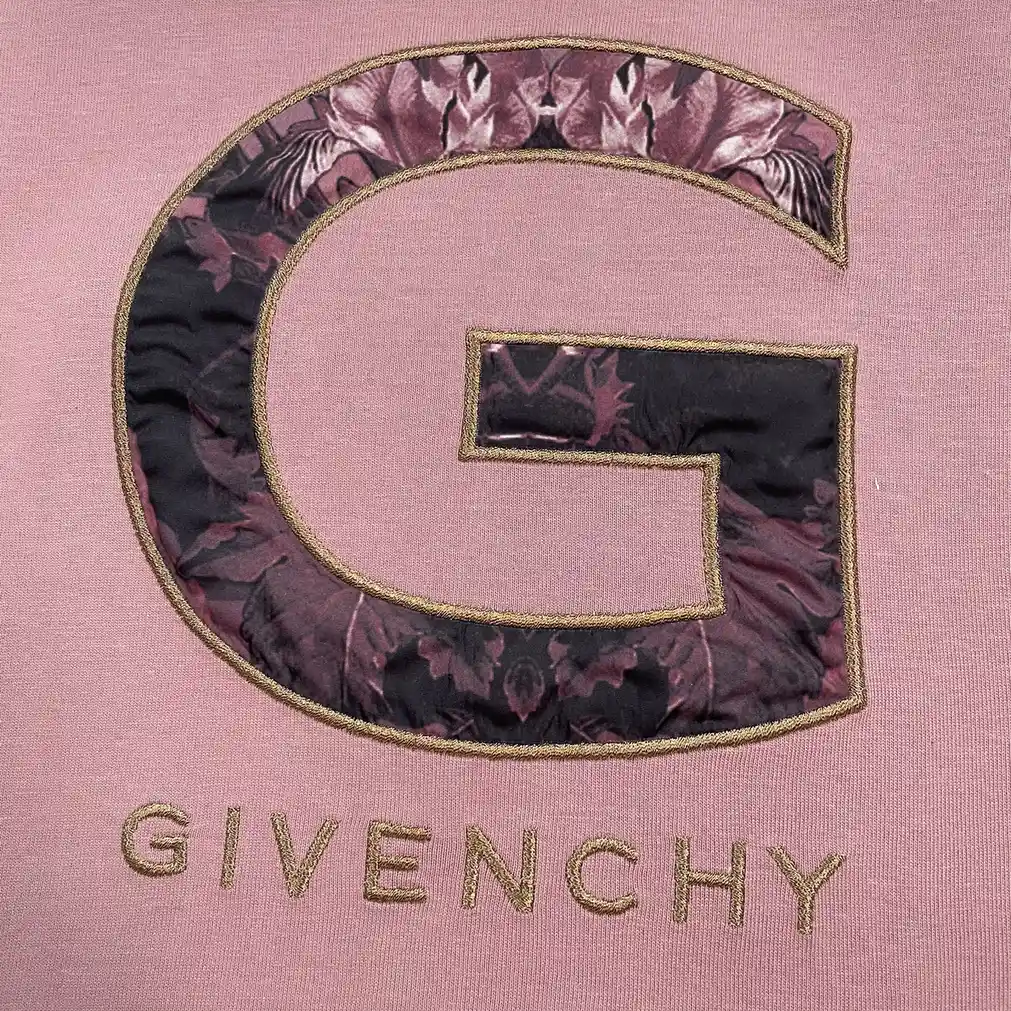
| Process Control Item | Standard Capability Metrics | Design & Engineering Notes |
|---|---|---|
| Residual Backing Material | 0% (zero paper backing, zero adhesive film, zero chemical solvents) | Pure thread stitching on the back; flat and soft, meeting infant Class A safe-contact standards. |
| Minimum Single-Line Stroke Width | ≥ 1.0 mm | Self-locking structure forms stably, keeping fine text and geometric lines crisp and sharp. |
| Minimum Letter Height for English Letters | Recommended ≥ 5.0 mm | Letters above 5 mm have clear outline edges and resist puckering and distortion. |
| Fabric Stretch Compatibility Range | Compatible with non-stretch wovens through 40% high-stretch double knits | Elastic pre-stress pattern engineering allows natural recovery after high-stretch extension and helps prevent thread pulling. |
| Maximum Embroidery Area per Design | Standard 400 mm × 400 mm | Supports direct embroidery for front-chest main labels, large lettering, and large back areas. |
| Wash Resistance and Care Standards | Suitable for regular machine washing (laundry bag recommended at ≤ 40°C water temperature); resists pulling and helps prevent thread breakage. |
Core Advantages (Pros):
Process Boundaries and Physical Limitations (Cons):
Common Garment Embroidery Placements and Recommended Sizes:
Recommended Fabrics: Ultra-soft modal, combed cotton jersey (160–260 gsm), Lycra high-stretch knits, ice-silk seamless fabric, lightweight wool knitwear, heavy sweatshirt fleece, vintage raw denim.
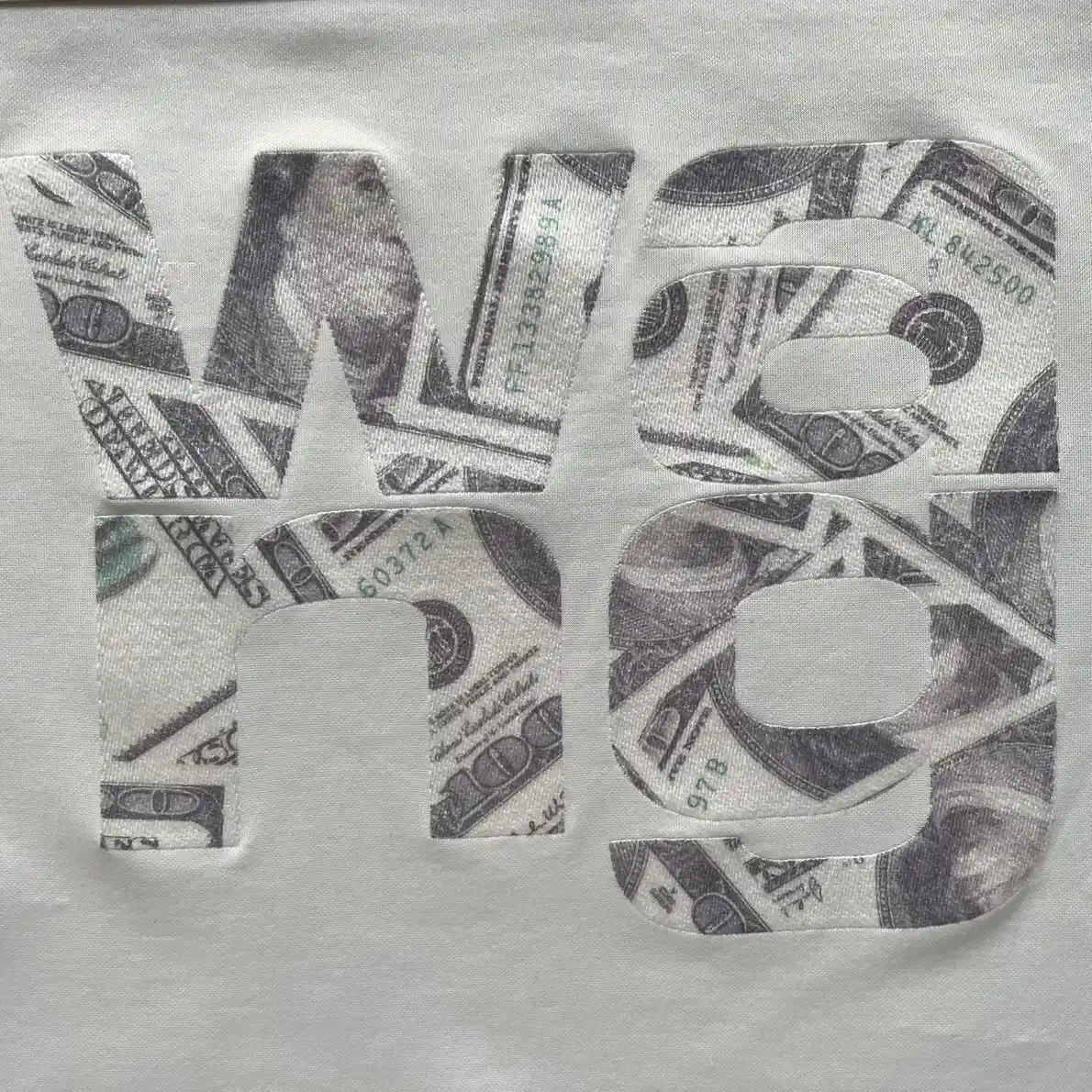
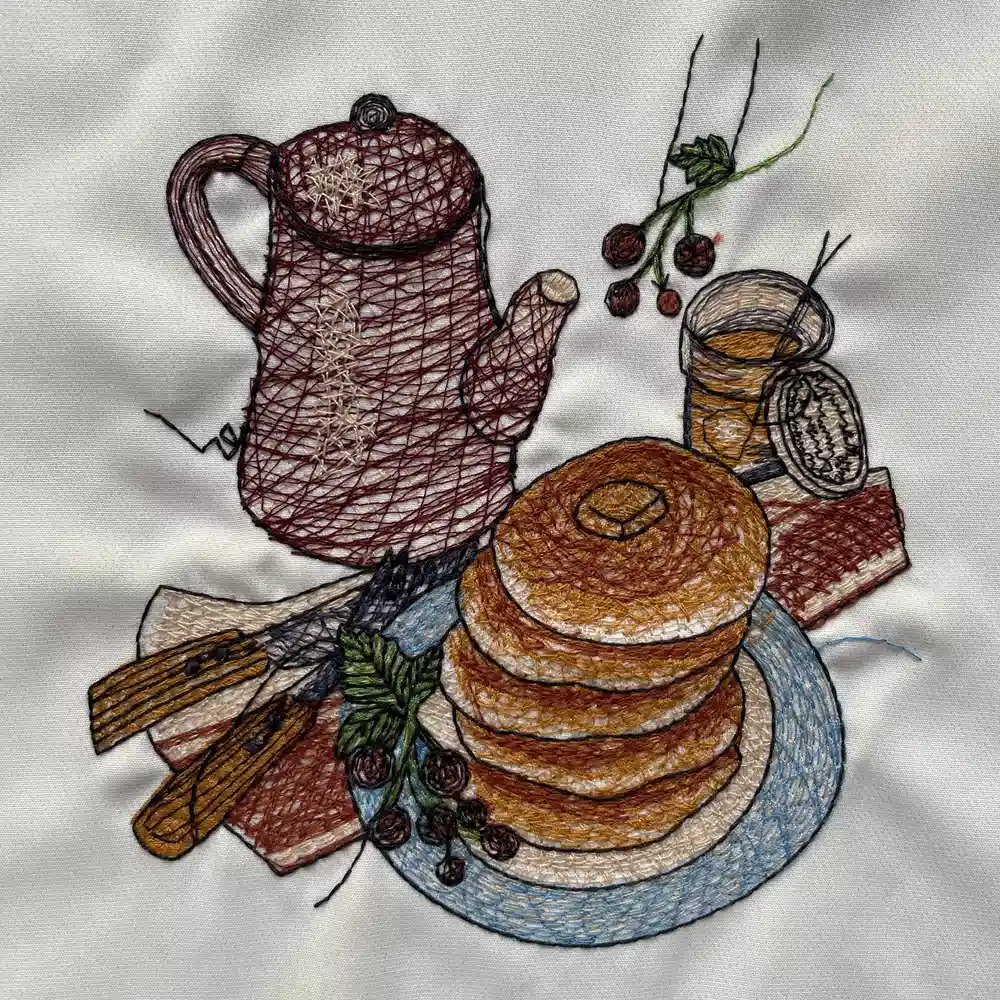
Backing-free technology can be used for standard thread embroidery and as a base for combining with other techniques:
| Backing process options | Backside residue | Skin feel and foreign-body sensation | Stretch performance on high-elastic fabrics | Finishing steps and lead time | Fabric quality risk |
|---|---|---|---|---|---|
| Dobest backing-free embroidery | No residue (pure stitching) | Soft, barely-there skin feel | Stretches in sync with the fabric without thread breakage | Finished directly off the machine; fast delivery | No high heat or washing required; lower quality risk |
| Traditional paper-backing embroidery (tear-away) | Leaves a ring of stiff paper fuzz/edge | Noticeably itchy and scratchy; hardens with washing | Very poor; pulling can tear the fabric | Requires time-consuming manual tearing of paper backing | Tearing can damage stitch holes and threads |
| Water-soluble film backing embroidery | No residue after washing | Good softness | Moderate; limited elastic release | Finished garments must be batch-washed, rinsed, and dried | Garment shrinkage, color change, and wrinkling |
| Hot-melt adhesive film backing embroidery | Removed by high-temperature pressing (localized hard film/micro-adhesive) | Adhesive hardens and stiffens after cooling | Relatively poor; adhesive has no elasticity | Requires high-temperature pressing to peel off the adhesive film | Synthetics may be prone to heat-induced whitening and glazing |
Q1 | Will backing-free embroidery unravel or distort after multiple washes?
No. Backing-free embroidery uses precise three-dimensional mesh self-locking stitches to interlace bobbin and top threads tightly. The embroidery thread forms a stable mechanical structure throughout, and under normal washing and wear, its durability is comparable to or even better than traditional paper-backed embroidery. For regular machine washing, use a laundry bag and wash at room temperature (≤ 40°C).
Q2 | When high-stretch yoga wear is stretched, can backing-free embroidery tear the fabric?
Traditional backed embroidery, with its hard and brittle backing, can indeed be prone to tearing fabric when pulled; Dobest backing-free technology presets elastic stretch allowance in the digitizing stage according to the fabric's stretch curve, so the embroidery extends and rebounds in sync with the fabric. In practical testing, stretching is less likely to cause thread breakage or yarn rupture.
Q3 | Can any ordinary embroidery factory produce backing-free embroidery?
No. Ordinary embroidery machines without component modification and tension control may cause severe fabric puckering, fabric damage, or even holes when embroidering directly without backing paper. Dobest has independently modified dedicated machines and professional stretch digitizing algorithms to help maintain stable bulk production quality.
Q4 | Is backing-free embroidery much more expensive than traditional backed embroidery?
Not necessarily. Although it requires higher machine setup and digitizing precision in the early stage, backing-free embroidery saves the cost of paper backing/adhesive film materials and further avoids secondary-process costs for manual paper tearing, high-temperature pressing, or washing and drying, as well as fabric loss risks. In bulk production, the overall cost is more cost-effective.
Dongguan Dobest Industrial Co., Ltd. (Dobest) was founded in 2013 and has focused on R&D and manufacturing of specialty computerized embroidery for 13 years. It has a 3,000 m² modern production workshop and more than 30 specialty embroidery computerized machines. It has passed Disney ILS and adidas SEA international brand factory audits and has been rated an A-level taxpayer for four consecutive years. We support custom R&D from drawings and samples, as well as rapid-response sampling.
Service hotline / WeChat: 13712297700 | Official website: dobest.hk | Submit a sampling request online
We can meet clients on-site in Pearl River Delta cities such as Dongguan, Shenzhen, Foshan (including Shunde), Zhongshan, Guangzhou, Zhuhai, Huizhou, and Jiangmen. For the Guangzhou urban area and surrounding districts (Haizhu, Liwan, Tianhe, Baiyun, Huangpu, Panyu, Huadu, Nansha, Conghua, Zengcheng) and Dongguan’s local towns and subdistricts (Humen, Houjie, Chang’an, Dalang, Changping, Dalingshan, Shipai, Chashan, Tangxia, Liaobu, Dongcheng, Nancheng, Wanjiang, etc.), we can usually visit on-site within half a day to discuss and review samples.
Hotline / WeChat:
137-1229-7700 2/F, Bldg E, Jinmao Xincheng, No.7 Jiedong South Rd, Xiaojiejiao, Humen, Dongguan, Guangdong, China Phone: 0769-81517903
 mclau@dobest.hk
Hotline:
13712297700
0769-81517903